
Prehistoric Pages
Something's not right here...

Anyone who believes that these boulders, weighing up to 350 tons, were transported by the Incas
hundreds of kilometers and over a thousand meters of elevation without iron tools or transportation is beyond help.
According to official archaeology, all of this took place during the Inca period, from the 13th to the
16th centuries. Shortly afterward, the Spanish arrived and found neither tools nor means of transport.
The blocks of the so-called Temple of the Sun lie scattered haphazardly across the landscape near
Ollantaytambo on a steep hill in the Sacred Valley of Peru. This could not possibly have been accomplished using Inca
technology. It must have been another civilization that possessed superior technology.
Unknown civilizations, why not?

Let's consider how long it took for our modern civilization to leap from a primitive agricultural culture into the atomic age. A thousand years before Christ, agriculture was practiced in the Near East, and people lived in cities made of unfired mud bricks. At the time, this was the high-tech region. In Europe, people lived in log cabins lined with hides and straw. Three thousand years later, humanity sent spacecraft to Mars, and no extraterrestrials were needed to provide technological assistance.
What if such a period already existed once before, for example, between 16,000 and 10,000 years before the Common Era? Then came the sudden end of the Ice Age, and the sea level rose by more than 70 meters. This civilization, whose cities were almost all located on the coasts, just like our modern civilization, disappeared beneath the waves. All that remained was the legend of Atlantis.
It's an unsettling thought that civilizations can also disappear completely. That's why we prefer to suppress it. But we shouldn't, because only those who know what can happen have the opportunity to take precautions to prevent it from happening again.
All over the world, there are enigmatic structures that could never have been built with the known tools of antiquity. The pyramids in Egypt are just the most famous example. The other examples on this page are from Peru, where many such structures can be visited in the Sacred Valley.
Ollantaytambo - Technical Details

The stones fit together seamlessly with an incredible precision. This could not have been achieved with stone or copper tools. It's not always soft sandstone; often it's granite, which is considerably harder (see image below).
To further enhance the effect, the joints are curved, and the stones are sometimes convex on the inside to increase their strength during earthquakes. Such accuracy would be impossible without precision measurements.

Machu Pichu - Layers of different civilizations
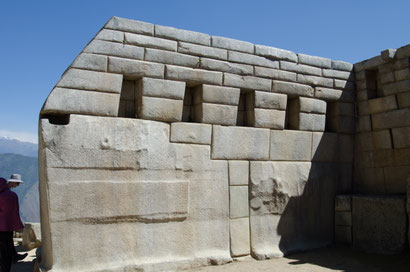
This image beautifully illustrates how different layers are superimposed. The Incas built upon existing structures, constructing over the enormous blocks, and it's evident that the quality of workmanship decreases layer by layer as one moves upwards. The lowest layers are the most precise; at the top, the stones are often simply roughly hewn and laid on top of each other, while at the bottom they are precisely interlocked.
Anyone who wants to read more about it can find further details in the novel "The Peruvian".